Airpals logo
Log In
Contact Us
  1. Home
  2. Shipping
  3. Shipping vs. Delivery: Common Misconceptions (Cleared Up)
shipping vs delivery
• 9 min read

Shipping vs. Delivery: Common Misconceptions (Cleared Up)

“Shipped” doesn’t mean “delivered.” Learn the real difference between shipping vs delivery and how it affects parcel operations.
Author avatar
Jose BorotoPublished: Dec 8, 2025Updated: Dec 9, 2025

The right terminology within the working environment is often overlooked, because we believe that concepts are understood exactly the same by everyone. But language is full of quirks and specific terms that require special attention. For example, teams often use the terms shipping and delivery interchangeably. This small mix-up creates real operational consequences for businesses that manage high parcel volumes.

This guide breaks down the actual distinction between shipping vs delivery, explains why the two concepts matter for planning and cost control, and clarifies the most common misconceptions found online.

After establishing a clear definition of each term, we will explore how modern Parcel Management Software helps unify both processes so teams can track the full lifecycle of a parcel from creation to final handoff and how Airpals has already found the sweet spot.

Table of Contents:

  1. What is Shipping?
  2. What is Delivery?
  3. Shipping vs. Delivery: What’s the difference?
  4. When Should Businesses Use Shipping vs Delivery Services?
  5. How Can Parcel Management Software Unify Shipping and Delivery Workflows?
  6. Key Takeaways
  7. Final Thoughts: How Should Businesses Apply These Insights To Improve Parcel Operations?
  8. Frequently Asked Questions (FAQs)

What Is Shipping?

Shipping is the phase in which a parcel is prepared, labeled, and handed off to a carrier. This step marks the official origin of the shipment and includes all the decisions and actions required before the package begins its journey.

Shipping usually includes:

  • Creating or importing shipment data
  • Generating compliant labels
  • Selecting a carrier and service level
  • Applying rates and rules
  • Initiating the first scan and handing off the parcel

Shipping describes the departure, not the arrival. This distinction is what creates confusion between shipment vs delivery and fuels questions like shipping and delivery difference or delivery or shipping when teams try to identify the correct terminology.

Once a package has been shipped, it enters carrier custody. At this point, the business loses direct control over movement, which is why accurate labeling, routing, and carrier selection are critical in this phase.

What Is Delivery?

Delivery is the final stage of the process: the physical handoff of a parcel to its recipient. Delivery happens after all transportation steps have been completed, and it typically involves a different set of responsibilities and workflows compared to shipping.

Delivery usually includes:

  • Local courier and last-mile operations
  • Attempted deliveries
  • Proof of delivery (POD) collection
  • Customer communication
  • Handling of address issues or access restrictions

Delivery defines the final experience. Even if shipping went smoothly, a delivery issue can result in dissatisfaction, support tickets, and returns. This is why many businesses search for answers to questions like the difference between shipped and delivered, or what is the difference between delivery and shipping.

Shipping vs Delivery: What’s the Difference?

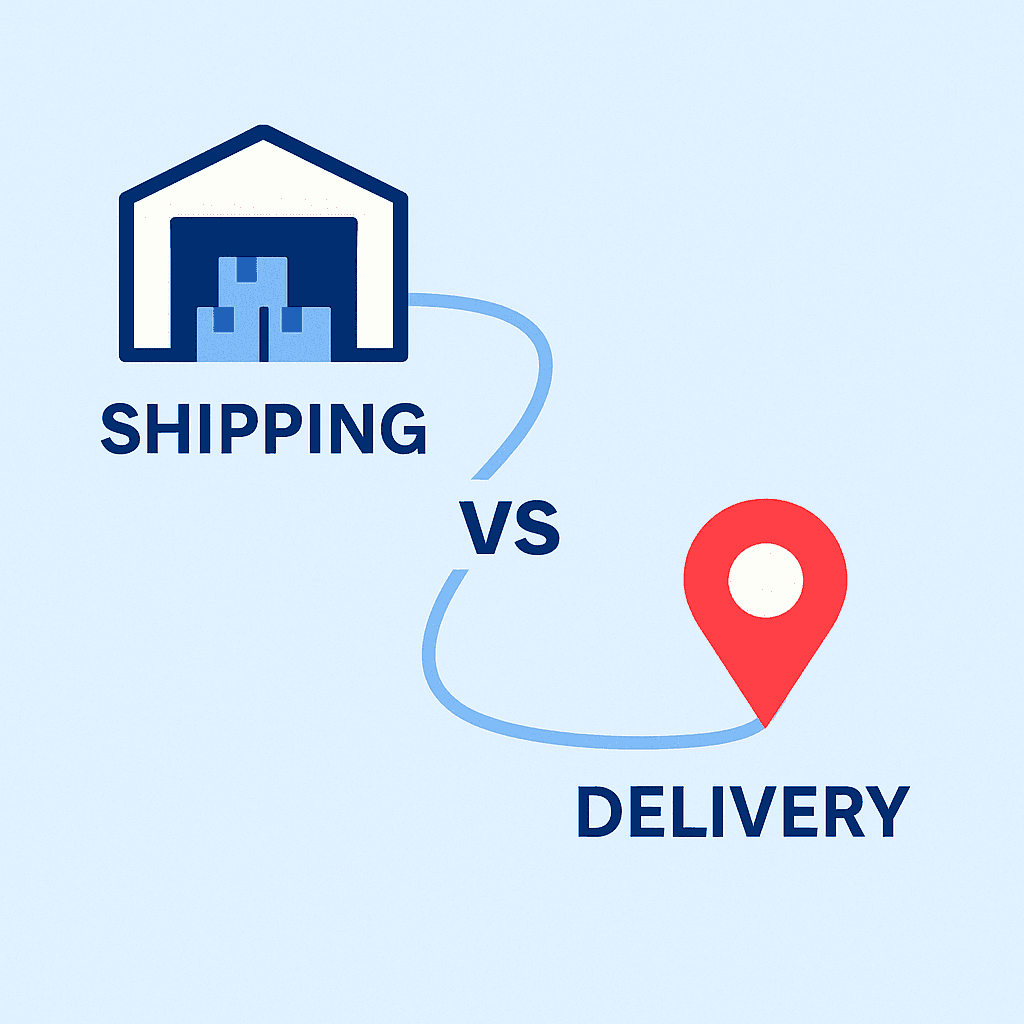
Shipping is the moment a parcel leaves the shipper. Delivery is the moment it reaches the recipient.

From an operational perspective:

  • Shipping focuses on preparation, documentation, and handoff.
  • Delivery focuses on execution, route completion, and recipient confirmation.
  • The two stages involve different teams, tools, and timelines.

Confusion between shipping versus delivery often leads to misinterpretation of notifications. For example, when a customer sees “Your package has shipped”, they may think it is already close to arriving. In reality, the package may still be at the origin facility and may not move until the carrier begins its route.

This misunderstanding creates internal friction and avoidable costs. A clear distinction between shipment vs delivery helps teams set proper expectations and reduces the number of support requests tied to miscommunication.

How Do Timelines and Responsibility Differ?

  • Shipping timeline: Begins when the label is created and ends when the carrier receives the parcel.
  • Delivery timeline: Begins when the parcel is in transit and ends when the recipient receives it.

Shipping responsibilities often fall under warehouse, fulfillment, and internal logistics teams. Delivery responsibilities typically fall under courier or last-mile partners.

When companies misjudge these roles, they assign accountability incorrectly. For example, a delay in pickup is a shipping issue, but a failed delivery attempt is a delivery issue. Without a clear distinction, teams misdiagnose problems and escalate them to the wrong stakeholders.

Why Do People Confuse Shipping vs Delivery So Often?

People frequently merge these two concepts due to:

1. Ambiguous retail language: Many online stores use “shipping” as a catch-all term for the entire process. They see the process from the outside, so for them the distinction might not feel like a crucial consideration.

2. Vague tracking notifications: A “shipped” status gives the impression of progress, even though the parcel may still be at the origin. Think of it like this: the package has been processed, but yours is not the only package being processed. Let’s just wait for the update. I know, not ideal.

3. Fragmented operational tools: When shipping and delivery are managed by different systems, carriers, or couriers, teams lose visibility into the full journey.

When Should Businesses Use Shipping vs Delivery Services?

Businesses select shipping or delivery services based on distance, urgency, and operational constraints. Shipping services support the movement of parcels across states or countries. Delivery services support the final mile, ensuring that parcels reach the recipient in a predictable time window.

Understanding these distinctions allows businesses to choose the right combination of services and avoid misaligned expectations between customers, carriers, and internal teams.

What Are the Different Kinds of Shipping?

Shipping options include:

  • Ground shipping: predictable, cost-efficient, ideal for non-urgent parcels.
  • Air shipping: faster transit times with higher cost.
  • International shipping: involves customs, documentation, duties, and compliance requirements.

Each type comes with unique rules, pricing structures, and carrier behavior.

What Are the Different Kinds of Delivery?

Delivery services cover a distinct set of use cases:

  • Same-day delivery: Local delivery service for time-sensitive shipments to be completed within the same day.
  • Next-day delivery: broader coverage but more limited than standard shipping.
  • Scheduled delivery: time-window-based drop-offs.
  • White glove delivery: specialized handling, installation, or value-added services.

Delivery depends heavily on local routing, address accuracy, and real-time communication with the final user. A business may ship efficiently but still face complaints if its delivery processes lack consistency or visibility.

Are There Cases Where Shipping and Delivery Work Together?

Almost all parcel workflows require both. Every parcel must be shipped and then delivered. The issue is not the sequence but the visibility between them.

When businesses track shipping and delivery in separate systems, gaps appear in:

  • Status accuracy
  • Handoff validation
  • Cost reconciliation
  • Delivery performance insights

This disconnect creates operational blind spots. Teams cannot answer basic questions from customers because they lack full-route traceability. A unified view solves this problem.

How Can Parcel Management Software Unify Shipping and Delivery Workflows?

A modern Parcel Management System (PMS) brings both stages together in a single operational layer.

A PMS typically includes:

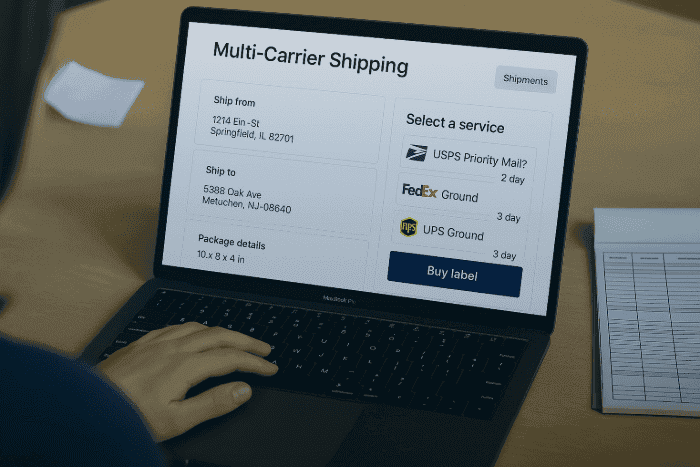
  • Multi-carrier shipping capabilities
  • Automated label creation
  • Same-day local delivery
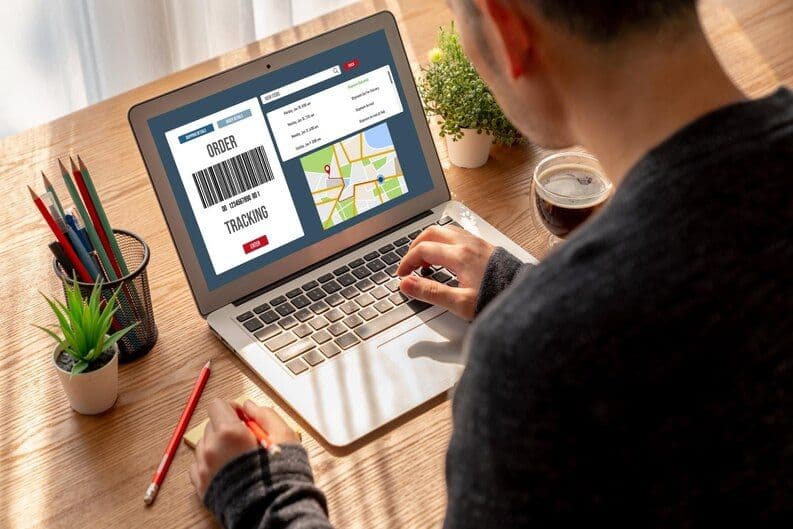
  • Consolidated tracking
  • Exception alerts and reporting
  • A centralized dashboard for full parcel visibility

Platforms like Airpals Parcel Management System follow this model by allowing teams to execute both shipping and delivery workflows from one place, choosing the right service type based on urgency, distance, and business needs.

By centralizing these functions, teams reduce tool fragmentation, simplify internal coordination, and avoid the operational friction that comes from switching between disconnected shipping and delivery systems. This becomes especially valuable in high-volume environments where consistency and process alignment directly impact efficiency and cost control.

For a detailed breakdown of PMS features and use cases, check our blog about Parcel Management Software Explained: Features, Benefits, and Use Cases.

Key Takeaways

  • Shipping and delivery represent two distinct operational stages.
  • Shipping manages the origin, while delivery manages the final handoff.
  • Confusing the two creates avoidable errors, customer complaints, and financial inefficiencies.
  • Businesses need visibility into both processes to improve reliability and cost control.
  • A Parcel Management System unifies shipping and delivery to give teams complete oversight of their operations.

Final Thoughts: How Should Businesses Apply These Insights to Improve Their Parcel Operations?

Understanding the difference between shipping and delivery is not just a matter of terminology; it shapes how a business allocates resources, communicates with partners, and evaluates performance. When teams treat both stages as a single process, they overlook the operational risks created by gaps in visibility.

Airpals brings these insights together through a unified platform. The system centralizes nationwide shipping, manages same-day delivery, and provides end-to-end traceability inside a single Parcel Management System. Instead of juggling fragmented tools, teams gain one operational source of truth that simplifies workflows, reduces errors, and strengthens operational efficiency.

Curious about where your current operation stands? Request a complimentary diagnostic call and discover how a unified approach to shipping and delivery can improve speed, accuracy, and operational control.

difference between shipment and delivery

Frequently Asked Questions (FAQs)

What is the difference between delivery and shipping?

Delivery refers to the final handoff of a parcel to the recipient, while shipping describes the preparation, labeling, and dispatch of that parcel from the origin. Understanding this difference helps teams interpret tracking updates correctly and manage timelines, responsibilities, and customer expectations effectively overall.

Does shipping mean delivery?

Shipping does not mean delivery. Shipping indicates that a parcel has been prepared, labeled, and handed to a carrier, marking the beginning of its journey. Delivery represents the final stage in which the parcel reaches the recipient.

What does shipping mean?

Shipping means a parcel has been created, processed, labeled, and transferred to a carrier so it can begin moving through the transportation network. It marks the start of the logistics cycle, not the end.

What’s the difference between shipped and delivered?

Shipped means a parcel has left the origin, received its initial scan, and entered the carrier’s custody. Delivered means the parcel has completed transit and reached the intended recipient. This difference clarifies the journey’s start and finish, helping teams interpret tracking updates correctly and reduce confusion between shipment vs delivery.

What does delivery mean?

Delivery is the final stage of the parcel journey, when the package is routed through last-mile operations and handed to the intended recipient. It confirms successful completion of the logistics cycle.


Author:
Author avatar
Jose BorotoBilingual Creative Copywriter
A writer with over 6 years of experience who enjoys making tricky logistics and tech topics feel simple. With his unique blend of creativity and analytical thinking, he helps readers make sense of innovations shaping the shipping world.
What is Airpals?We help companies streamline corporate shipping by centralizing all carrier accounts in one place to drive operational efficiency: from FedEx and UPS to same-day local couriers.Learn More
The First AI-Powered Shipping Platform
An airpal orchestrating the delivery
Let AI handle it for you! Compare rates in seconds and get up to 89% discounts from top carriers.Try our AI Shipping Calculator

The right terminology within the working environment is often overlooked, because we believe that concepts are understood exactly the same by everyone. But language is full of quirks and specific terms that require special attention. For example, teams often use the terms shipping and delivery interchangeably. This small mix-up creates real operational consequences for businesses that manage high parcel volumes.

This guide breaks down the actual distinction between shipping vs delivery, explains why the two concepts matter for planning and cost control, and clarifies the most common misconceptions found online.

After establishing a clear definition of each term, we will explore how modern Parcel Management Software helps unify both processes so teams can track the full lifecycle of a parcel from creation to final handoff and how Airpals has already found the sweet spot.

Table of Contents:

  1. What is Shipping?
  2. What is Delivery?
  3. Shipping vs. Delivery: What’s the difference?
  4. When Should Businesses Use Shipping vs Delivery Services?
  5. How Can Parcel Management Software Unify Shipping and Delivery Workflows?
  6. Key Takeaways
  7. Final Thoughts: How Should Businesses Apply These Insights To Improve Parcel Operations?
  8. Frequently Asked Questions (FAQs)

What Is Shipping?

Shipping is the phase in which a parcel is prepared, labeled, and handed off to a carrier. This step marks the official origin of the shipment and includes all the decisions and actions required before the package begins its journey.

Shipping usually includes:

  • Creating or importing shipment data
  • Generating compliant labels
  • Selecting a carrier and service level
  • Applying rates and rules
  • Initiating the first scan and handing off the parcel

Shipping describes the departure, not the arrival. This distinction is what creates confusion between shipment vs delivery and fuels questions like shipping and delivery difference or delivery or shipping when teams try to identify the correct terminology.

Once a package has been shipped, it enters carrier custody. At this point, the business loses direct control over movement, which is why accurate labeling, routing, and carrier selection are critical in this phase.

What Is Delivery?

Delivery is the final stage of the process: the physical handoff of a parcel to its recipient. Delivery happens after all transportation steps have been completed, and it typically involves a different set of responsibilities and workflows compared to shipping.

Delivery usually includes:

  • Local courier and last-mile operations
  • Attempted deliveries
  • Proof of delivery (POD) collection
  • Customer communication
  • Handling of address issues or access restrictions

Delivery defines the final experience. Even if shipping went smoothly, a delivery issue can result in dissatisfaction, support tickets, and returns. This is why many businesses search for answers to questions like the difference between shipped and delivered, or what is the difference between delivery and shipping.

Shipping vs Delivery: What’s the Difference?

Shipping is the moment a parcel leaves the shipper. Delivery is the moment it reaches the recipient.

From an operational perspective:

  • Shipping focuses on preparation, documentation, and handoff.
  • Delivery focuses on execution, route completion, and recipient confirmation.
  • The two stages involve different teams, tools, and timelines.

Confusion between shipping versus delivery often leads to misinterpretation of notifications. For example, when a customer sees “Your package has shipped”, they may think it is already close to arriving. In reality, the package may still be at the origin facility and may not move until the carrier begins its route.

This misunderstanding creates internal friction and avoidable costs. A clear distinction between shipment vs delivery helps teams set proper expectations and reduces the number of support requests tied to miscommunication.

How Do Timelines and Responsibility Differ?

  • Shipping timeline: Begins when the label is created and ends when the carrier receives the parcel.
  • Delivery timeline: Begins when the parcel is in transit and ends when the recipient receives it.

Shipping responsibilities often fall under warehouse, fulfillment, and internal logistics teams. Delivery responsibilities typically fall under courier or last-mile partners.

When companies misjudge these roles, they assign accountability incorrectly. For example, a delay in pickup is a shipping issue, but a failed delivery attempt is a delivery issue. Without a clear distinction, teams misdiagnose problems and escalate them to the wrong stakeholders.

Why Do People Confuse Shipping vs Delivery So Often?

People frequently merge these two concepts due to:

1. Ambiguous retail language: Many online stores use “shipping” as a catch-all term for the entire process. They see the process from the outside, so for them the distinction might not feel like a crucial consideration.

2. Vague tracking notifications: A “shipped” status gives the impression of progress, even though the parcel may still be at the origin. Think of it like this: the package has been processed, but yours is not the only package being processed. Let’s just wait for the update. I know, not ideal.

3. Fragmented operational tools: When shipping and delivery are managed by different systems, carriers, or couriers, teams lose visibility into the full journey.

When Should Businesses Use Shipping vs Delivery Services?

Businesses select shipping or delivery services based on distance, urgency, and operational constraints. Shipping services support the movement of parcels across states or countries. Delivery services support the final mile, ensuring that parcels reach the recipient in a predictable time window.

Understanding these distinctions allows businesses to choose the right combination of services and avoid misaligned expectations between customers, carriers, and internal teams.

What Are the Different Kinds of Shipping?

Shipping options include:

  • Ground shipping: predictable, cost-efficient, ideal for non-urgent parcels.
  • Air shipping: faster transit times with higher cost.
  • International shipping: involves customs, documentation, duties, and compliance requirements.

Each type comes with unique rules, pricing structures, and carrier behavior.

What Are the Different Kinds of Delivery?

Delivery services cover a distinct set of use cases:

  • Same-day delivery: Local delivery service for time-sensitive shipments to be completed within the same day.
  • Next-day delivery: broader coverage but more limited than standard shipping.
  • Scheduled delivery: time-window-based drop-offs.
  • White glove delivery: specialized handling, installation, or value-added services.

Delivery depends heavily on local routing, address accuracy, and real-time communication with the final user. A business may ship efficiently but still face complaints if its delivery processes lack consistency or visibility.

Are There Cases Where Shipping and Delivery Work Together?

Almost all parcel workflows require both. Every parcel must be shipped and then delivered. The issue is not the sequence but the visibility between them.

When businesses track shipping and delivery in separate systems, gaps appear in:

  • Status accuracy
  • Handoff validation
  • Cost reconciliation
  • Delivery performance insights

This disconnect creates operational blind spots. Teams cannot answer basic questions from customers because they lack full-route traceability. A unified view solves this problem.

How Can Parcel Management Software Unify Shipping and Delivery Workflows?

A modern Parcel Management System (PMS) brings both stages together in a single operational layer.

A PMS typically includes:

  • Multi-carrier shipping capabilities
  • Automated label creation
  • Same-day local delivery
  • Consolidated tracking
  • Exception alerts and reporting
  • A centralized dashboard for full parcel visibility

Platforms like Airpals Parcel Management System follow this model by allowing teams to execute both shipping and delivery workflows from one place, choosing the right service type based on urgency, distance, and business needs.

By centralizing these functions, teams reduce tool fragmentation, simplify internal coordination, and avoid the operational friction that comes from switching between disconnected shipping and delivery systems. This becomes especially valuable in high-volume environments where consistency and process alignment directly impact efficiency and cost control.

For a detailed breakdown of PMS features and use cases, check our blog about Parcel Management Software Explained: Features, Benefits, and Use Cases.

Key Takeaways

  • Shipping and delivery represent two distinct operational stages.
  • Shipping manages the origin, while delivery manages the final handoff.
  • Confusing the two creates avoidable errors, customer complaints, and financial inefficiencies.
  • Businesses need visibility into both processes to improve reliability and cost control.
  • A Parcel Management System unifies shipping and delivery to give teams complete oversight of their operations.

Final Thoughts: How Should Businesses Apply These Insights to Improve Their Parcel Operations?

Understanding the difference between shipping and delivery is not just a matter of terminology; it shapes how a business allocates resources, communicates with partners, and evaluates performance. When teams treat both stages as a single process, they overlook the operational risks created by gaps in visibility.

Airpals brings these insights together through a unified platform. The system centralizes nationwide shipping, manages same-day delivery, and provides end-to-end traceability inside a single Parcel Management System. Instead of juggling fragmented tools, teams gain one operational source of truth that simplifies workflows, reduces errors, and strengthens operational efficiency.

Curious about where your current operation stands? Request a complimentary diagnostic call and discover how a unified approach to shipping and delivery can improve speed, accuracy, and operational control.

difference between shipment and delivery

Frequently Asked Questions (FAQs)

What is the difference between delivery and shipping?

Delivery refers to the final handoff of a parcel to the recipient, while shipping describes the preparation, labeling, and dispatch of that parcel from the origin. Understanding this difference helps teams interpret tracking updates correctly and manage timelines, responsibilities, and customer expectations effectively overall.

Does shipping mean delivery?

Shipping does not mean delivery. Shipping indicates that a parcel has been prepared, labeled, and handed to a carrier, marking the beginning of its journey. Delivery represents the final stage in which the parcel reaches the recipient.

What does shipping mean?

Shipping means a parcel has been created, processed, labeled, and transferred to a carrier so it can begin moving through the transportation network. It marks the start of the logistics cycle, not the end.

What’s the difference between shipped and delivered?

Shipped means a parcel has left the origin, received its initial scan, and entered the carrier’s custody. Delivered means the parcel has completed transit and reached the intended recipient. This difference clarifies the journey’s start and finish, helping teams interpret tracking updates correctly and reduce confusion between shipment vs delivery.

What does delivery mean?

Delivery is the final stage of the parcel journey, when the package is routed through last-mile operations and handed to the intended recipient. It confirms successful completion of the logistics cycle.

Author:
Author avatar
Jose BorotoBilingual Creative Copywriter
A writer with over 6 years of experience who enjoys making tricky logistics and tech topics feel simple. With his unique blend of creativity and analytical thinking, he helps readers make sense of innovations shaping the shipping world.

Related Posts

net weight v gross weight
Shipping

Net Weight vs. Gross Weight: Key Differences for Shipping

Learn the difference between net versus gross weight and why it changes your shipping costs. Avoid mistakes and choose the right carrier with this guide.
Nov 18, 2025
Woman Shipping clothes in a box
Shipping

Shipping Clothes: Cheapest Way

Discover the cheapest way to ship clothing with simple tips on packaging, and choose the best boxes for cost-effective shipping!
Sep 12, 2024
woman-setting-up-smartphone-before-shooting-podcast
Shipping

How to Send Products to Influencers: A Guide to Influencer Gifting Campaigns

Learn about influencer marketing campaigns and the best way to ship your gifts and products. Discover how Airpals can streamline this task in your business.
May 10, 2024
Discover more posts
Airpals white logo
Facebook icon
Instagram icon
Twitter icon
Linkedin icon
Subscribe to our newsletter
FedEx UPS USPS Boxes
USPS vs UPS vs FedEx: Which is Best in 2025?
Delivery Male with Package List
How to Get Discounted Shipping Rates
About Us
For Companies
Pricing
Messenger Service in NYC
Multi-carrier Shipping Software
Shipping Cost Calculator
Same-Day Courier Other Cities
How It Works
Share Your Feedback
Help Center
Contact Us
Blog
Sitemap
Privacy Policy
Terms & Conditions:
T&C Multi-Carrier Shipping
T&C NYC Same-Day Delivery
Facebook icon
Instagram icon
Twitter icon
Linkedin icon