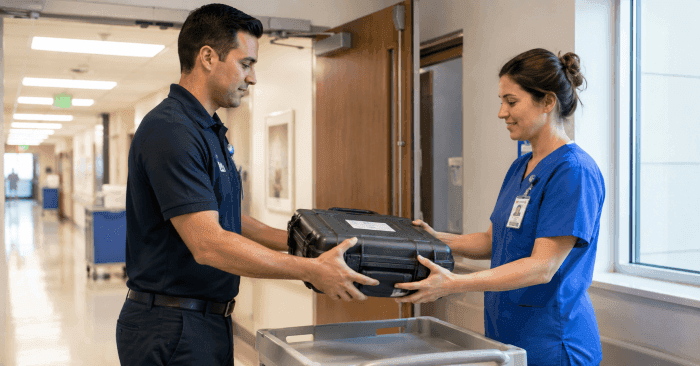
Medical logistics is one of the most time-sensitive and risk-sensitive segments of delivery operations. When healthcare teams move equipment between hospitals, clinics, laboratories, and surgical centers, they are not just shipping items; they are, most importantly, supporting patient care in real time.
This article explains what medical equipment delivery involves, why it requires specialized handling, and how healthcare organizations can choose the right courier partner. It also explores how same-day delivery solutions help facilities respond to urgent demands with speed, visibility, and reliability.
Table of Contents:
- What Is Medical Equipment Delivery?
- Types of Medical Equipment Commonly Transported
- Why Medical Equipment Delivery Is More Complex Than Standard Courier Jobs
- What to Look for in a Medical Equipment Delivery Service
- How Airpals Same-Day Courier Supports Medical Equipment Transport
- Key Takeaways
- Choosing a Medical Courier That Keeps Up With Critical Demands
- Frequently Asked Questions (FAQs)
What Is Medical Equipment Delivery?
Medical equipment delivery refers to the transportation of medical devices, diagnostic tools, and clinical supplies between healthcare facilities. This includes hospital-to-hospital transfers, clinic-to-lab shipments, and internal network logistics within healthcare systems.
Unlike standard parcel delivery, this type of medical delivery often requires strict timing, careful handling, and clear documentation.
It is important to distinguish this from home healthcare delivery. While home delivery focuses on delivering equipment such as oxygen tanks and mobility aids to patients, transportation of medical equipment between facilities supports operational continuity in healthcare settings. These deliveries are often coordinated by logistics teams, biomedical departments, or clinical staff who rely on rigorous execution.
Types of Medical Equipment Commonly Transported
Healthcare facilities rely on a wide range of equipment that must be moved safely and efficiently. One major category includes diagnostic and imaging tools, such as portable ultrasound machines, ECG machines, and X-ray components. These devices are often shared across locations or require servicing, making reliable medical device delivery essential.
Surgical instruments and sterile supply kits are another critical category. These items must arrive on time and in proper condition to support scheduled procedures. Any delay in a medical pick-up and delivery service can disrupt operating room schedules and lead to costly rescheduling.
Critical care devices such as infusion pumps, ventilators, and monitoring equipment are frequently transported between facilities. These devices directly support patient care, so their availability is often time-sensitive. Similarly, laboratory equipment and specimen processing devices must be moved quickly to maintain testing workflows.
Durable medical equipment (DME), including wheelchairs and hospital beds, is also commonly transported. While these items may seem less urgent, they still require coordination and proper handling to ensure they are ready for patient use upon arrival.
Why Medical Equipment Delivery Is More Complex Than Standard Courier Jobs
Timing and Clinical Consequences
Timing is one of the most critical factors in medical equipment delivery services. Unlike standard logistics, where delivery windows are flexible, healthcare deliveries are often tied directly to patient care schedules. A delayed shipment can postpone a surgery, delay a diagnosis, or extend a patient's hospital stay.
STAT deliveries, urgent, immediate shipments, are common in this environment. These requests are driven by clinical need, not convenience. According to guidance from the U.S. Department of Health & Human Services, timely access to medical resources is a key factor in maintaining quality care and operational efficiency.
Handling Sensitivity and Equipment Risk
Medical equipment is often sensitive to environmental conditions. Vibration, temperature changes, and static discharge can damage electronic components or compromise calibration. This is why medical courier equipment handling requires specialized processes, including protective packaging and trained drivers.
Chain of custody is another critical factor. Healthcare teams need confirmation that the correct equipment was delivered, in proper condition, to the right location. This often includes signatures, photo verification, and detailed tracking logs.
Some devices may also require specific vehicle configurations or shock-absorbing transport methods. A standard courier service may not be equipped to handle these requirements, increasing the risk of damage or delays.
Coordination Between Facilities
Medical logistics involves coordination between multiple stakeholders, including hospital logistics teams, biomedical engineers, and clinical staff. Miscommunication can lead to missed handoffs, incorrect shipments, or duplicate requests.
Real-time visibility is essential to reduce these risks. Tracking systems that help live updates teams stay aligned and reduce the need for constant follow-up calls. According to insights from Harvard Business Review, operational transparency is a key driver of efficiency in complex logistics environments.
A reliable medical delivery courier helps streamline communication by providing centralized tracking and clear delivery confirmation.

What to Look for in a Medical Equipment Delivery Service FALTA CAMBIAR
Choosing the right provider for medical equipment transportation requires evaluating several key capabilities. First, availability matters. Healthcare teams often need same-day or on-demand service, not just scheduled delivery windows. A provider that cannot respond quickly may not meet operational needs.
Tracking and proof of delivery are equally important. Look for services that offer real-time tracking, signature capture, and photo confirmation. These features provide accountability and reduce uncertainty.
Experience handling sensitive equipment is another critical factor. Not all couriers are equipped to manage fragile or high-value medical devices. A specialized medical delivery provider will have processes in place to minimize risk.
Chain of custody documentation ensures that every step of the delivery is recorded. This is particularly important for compliance and internal auditing. Additionally, responsive dispatch teams that can adapt to last-minute changes help maintain flexibility in dynamic environments.
Finally, the coverage area should align with your facility network. A medical pick-up and delivery service must be able to operate across all relevant locations to ensure consistent service.
How Airpals Same-Day Courier Supports Medical Equipment Transport
Healthcare teams increasingly rely on flexible, technology-driven solutions to manage logistics. Airpals Same-Day Courier and Messenger Services are designed to meet the demands of urgent, facility-to-facility delivery.
- Airpals offers on-demand same-day courier and messenger services for urgent pickups and deliveries.
- The platform is built for point-to-point delivery between facilities.
- Real-time tracking, proof of delivery, and a simple dispatch process reduce coordination overhead.
- The service is a natural fit for healthcare operations teams, facilities coordinators, and clinical logistics managers.
- Flexible dispatch allows teams to adapt to last-minute changes without operational friction.
By focusing on speed, visibility, and ease of use, Airpals supports the unique requirements of medical equipment delivery services without adding complexity to existing workflows.
Key Takeaways
- Medical logistics requires a higher level of precision than standard delivery services.
- Timing constraints and specialized handling directly impact patient care and operational efficiency.
- Healthcare teams should evaluate factors such as real-time tracking, chain of custody, and proper equipment handling when choosing a provider.
- A reliable medical delivery courier can help reduce delays, improve coordination, and ensure critical equipment arrives safely.
- Same-day delivery solutions are essential for handling urgent medical demands.
- Fast, trackable, and flexible delivery services help healthcare organizations maintain continuity and respond quickly to changing needs.
Choosing a Medical Courier That Keeps Up With Critical Demands
Selecting the right courier for medical device delivery is not just a logistics decision; it is a strategic choice that impacts patient care, operational efficiency, and team productivity. Healthcare organizations need partners that understand the urgency, complexity, and sensitivity of their delivery requirements.
A strong medical equipment transportation provider offers more than speed. It provides visibility, reliability, and the ability to adapt to real-world challenges. From handling fragile devices to coordinating across multiple facilities, the right courier helps reduce risk and improve outcomes.
If your team needs a solution that can keep up with critical demands, consider exploring Airpals Concierge (Same-Day Courier & Messenger Services). With a focus on real-time tracking, on-demand dispatch, and streamlined coordination, it offers a practical approach to modern healthcare logistics.

Frequently Asked Questions (FAQs)
What is medical equipment delivery?
Medical equipment delivery is the transport of medical devices, instruments, and supplies between healthcare facilities. It requires specialized handling, precise timing, and clear documentation to support clinical operations.
How fast can a courier deliver medical equipment?
A medical delivery courier can often complete deliveries the same day, depending on distance and urgency.
Do medical equipment couriers provide proof of delivery?
Yes, most medical equipment delivery services provide proof of delivery features such as signatures, photo confirmation, and real-time tracking to ensure accountability.
When should a healthcare facility use a same-day courier instead of a carrier?
Facilities should use a same-day medical pick-up and delivery service when timing is critical, such as for urgent procedures, equipment transfers, or situations where delays could impact patient care.